Summary: Yes, a pay-once sound pack can be worth the money when its sounds fit your genre, return to your projects regularly, and reduce preset hunting. The strongest purchase combines useful presets with clear licensing, compatible formats, reliable performance, and a price you can recover through repeated beatmaking, placements, or commercial releases.
Is a pay-once sound pack worth the money? It can be, but only when you are buying a working tool rather than another folder of sounds. The right pack should help you finish beats faster, support your main genres, and remain useful across multiple projects. Our lite vs full sound bank comparison can help you decide whether a smaller entry edition or a broader instrument fits your workflow.
The real calculation is not the number of presets on the sales page. It is the number of sounds you will actually use, how often you reuse them, whether the license covers your releases, and whether the instrument works smoothly in your DAW. A focused pack can be a practical alternative to paying for ongoing access to a large library you rarely open.
When does a pay-once sound pack justify its upfront price?
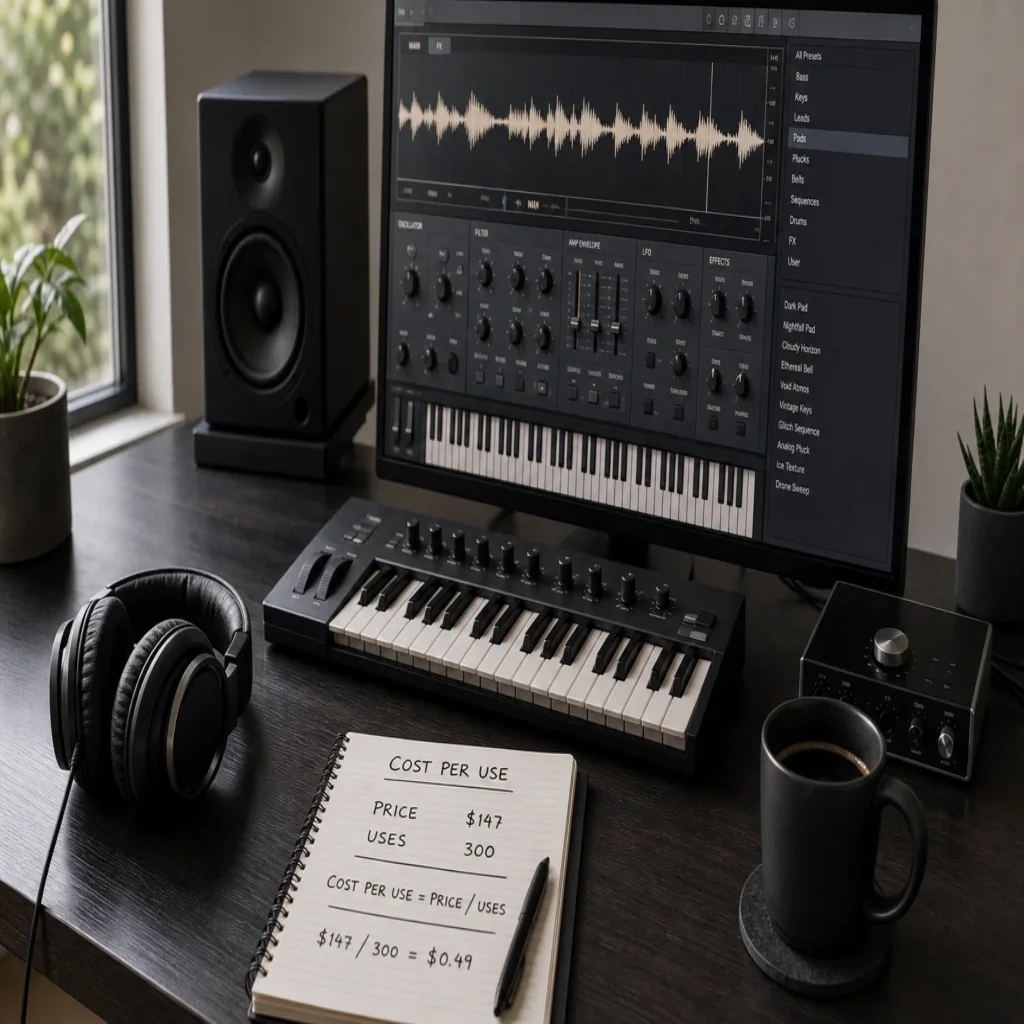
Start with expected reuse. If a sound pack costs $147 and you use it in 30 finished beats, the purchase works out to $4.90 per beat before considering the time saved. If you only use two presets once and never return to the pack, even a low price may represent poor value.
This is why a curated sound bank can be more useful than an enormous collection. A smaller set of relevant bells, pads, plucks, 808s, drums, MIDI patterns, and effects gives you a better chance of finding the right material quickly. A general overview of paid and free sample packs also identifies curation, consistency, and licensing clarity as practical reasons producers pay for selected content, while noting that popular packs can still become repetitive. Read Octaton’s comparison for that broader perspective.
For a beatmaker working repeatedly in trap, drill, phonk, dark trap, boom bap, pluggnb, or melodic R&B, genre fit can make the calculation favorable. You are not paying for every possible style. You are paying for a tool that matches the sessions you actually make.
What are you actually buying?
A pay-once sound pack may contain one-shot samples, loops, MIDI, presets for a synthesizer, or a complete virtual instrument. These products are not interchangeable. A folder of WAV files gives you raw material, while a VST instrument can provide a more direct beatmaking workflow with presets, effects, and sound shaping in the same interface.
Our Pendora full edition is designed as a broader sound-bank workflow. It includes more than 275 studio-ready presets, three expansion packs, a Producer Kit, two drumkits, MIDI content, an FX pack, and risers. That combination matters because it lets you move from a melodic idea to drums, effects, and arrangement material without switching between several unrelated libraries.
The full edition is listed at €149 on some Tiger-Sounds pages and $147 on another, so the checkout currency should be checked before purchase. You can review the current details on our Pendora sound pack price page before deciding whether the larger package matches your needs.
The value is especially clear when the pack complements instruments you already use. Serum, Omnisphere, Kontakt, and Vital may cover broad synthesis or sampled-instrument needs, while a focused sound bank can give you a faster starting point for a specific production lane. It does not need to replace your entire setup to justify its cost.
Why does genre fit matter more than library size?
Preset quantity is easy to advertise, but relevance is harder to measure. A producer may prefer 30 sounds that immediately fit a dark trap beat over 300 sounds that require extensive filtering, layering, and processing before they feel usable.
For that reason, a genre-focused plugin can help reduce beatblock. Pendora is built around trap, drill, dark trap, phonk, boom bap, pluggnb, melodic R&B, and related styles rather than attempting to cover every genre. The intended benefit is a shorter path from opening the DAW to finding a sound that already belongs in the track.
Distinctiveness also matters, although it should be treated as a positioning claim rather than a guaranteed result. Tiger-Sounds describes Pendora presets as hand-crafted, non-licensed, non-generated, and non-recycled. That approach is intended for producers who want alternatives to generic, widely repeated sounds, but the final character of a beat still depends on arrangement, processing, performance, and mixing decisions.
A useful test is simple: load the demos into FL Studio, Ableton, or Logic Pro and ask whether the sounds suggest several track ideas without heavy editing. If the answer is yes, the pack may be doing more than expanding your library. It may be improving the speed and direction of your creative decisions.
Pay once or subscribe: which model matches your workflow?
Subscriptions and one-time purchases solve different problems. A subscription is useful when you need constant discovery, large-scale search, or new material for many unrelated projects. A pay-once pack is more suitable when you want dependable access to a focused tool and expect to reuse it after the month of purchase has passed.
A 2024 analysis of subscription and perpetual software licenses recommends comparing the upfront price with how often meaningful updates arrive and how long you expect to use the product. That reasoning applies to sound tools as well. You can read the 2024 license analysis for a wider discussion of ownership, updates, and recurring costs.
The comparison becomes clearer when you ask what happens after 12 or 24 months. With a pay-once sound pack, you normally retain access to the purchased content under its license terms. With a subscription, ongoing access, new downloads, or certain platform features may depend on an active plan. Neither model is automatically right for every producer, but the recurring cost should be part of the decision.
Pay-once ownership is often preferable for beatmakers who sell or license beats over a long period. You can reopen an older FL Studio, Ableton, or Logic Pro project and return to the same presets without maintaining a monthly sound-library payment. That continuity can be valuable when your catalog develops gradually rather than through a short production sprint.
Which licensing and compatibility checks should come first?
Before paying, confirm four details: commercial usage, redistribution restrictions, plugin format, and operating-system support. A pack may be described as royalty-free but still prohibit sharing the raw files, reselling presets, or distributing the original content as part of another library.
Pendora products include royalty-free commercial usage under the stated licensing terms, so you can use the sounds in beats you sell, place, or license. Account sharing and redistribution are excluded. That distinction is important because using a sound in a finished musical work is different from giving the original preset or sample files to another person.
For technical compatibility, Pendora supports VST3 on Windows and macOS, while AU is supported on macOS. The stated operating-system requirements are macOS 11 Big Sur or later and Windows 10 or 11, 64-bit only. Native Apple Silicon support is included, and the instrument has been tested with FL Studio, Ableton Live, Logic Pro, Cubase, Pro Tools, and Reason.
Check the format your DAW actually loads before checkout. A Mac producer may choose AU or VST3 depending on the host, while a Windows producer will generally need VST3. Compatibility with Apple Silicon, CPU, RAM, and disk space should also be considered before installing several instruments into a large project.
How can you avoid paying for presets you will not use?
The best protection against wasted spending is a short evaluation process. Listen to several demos in your target genres, identify the categories you use most, and check whether the pack includes production assets that support your normal workflow. Do not let a large preset count decide the purchase by itself.
- Define the production gap. Decide whether you need melodic ideas, dark 808s, drill drums, atmospheric pads, MIDI, effects, or a faster preset workflow.
- Check real project fit. Test the sounds in the DAW and system you use for beatmaking, not only in an online player.
- Review the license. Confirm commercial usage rights and make sure you understand the restrictions on sharing or redistribution.
- Estimate reuse. Consider how many beats, placements, or releases could realistically benefit from the pack.
- Start smaller when uncertain. Our Pendora Lite sound pack provides an evaluation-oriented entry point before moving to the full edition.
Organization is another part of value. A well-labeled library reduces the time spent searching, but even paid content needs sorting and tagging once it enters your system. An audio-library guide notes that paid collections are often easier to organize and curate than free sources, while also reminding users to inspect the license for each product. That practical point is covered in this audio-library guide.
Tiger-Sounds also displays a 4.71/5 rating from 59 verified-buyer reviews for the full edition and states that Pendora is used by more than 500 producers. Those figures are product-page claims, not a guarantee that every preset will suit every producer, but they provide useful context alongside demos, compatibility details, and the option to start with a smaller edition.
Who is most likely to benefit from a pay-once sound pack?
A pay-once pack is a strong fit for a producer who works repeatedly in a defined group of genres, wants fast access to a recognizable sound palette, and expects to use the instrument for more than a few sessions. It is also practical for producers who sell beats or license tracks and want commercial usage terms that are clear from the beginning.
It may be less suitable if you are still exploring many unrelated genres, rarely finish projects, or already own several instruments that cover the same sonic territory. In that situation, learning the tools you have may produce more value than adding another library.
The decision does not need to be permanent. Starting with an evaluation edition, comparing it with your existing Serum, Omnisphere, Kontakt, or Vital workflow, and upgrading only when the sounds repeatedly appear in finished projects keeps the purchase tied to actual use rather than impulse.
The practical verdict on pay-once sound packs
A pay-once sound pack can be worth the money when it solves a specific production problem, fits your genres, works in your DAW, and continues to earn its place across multiple projects. The most reliable calculation combines cost per use with time saved, licensing clarity, technical compatibility, and the number of sounds you genuinely expect to reuse.
Choose focused content over inflated preset counts, verify the license before releasing music, and test the workflow before committing to a larger edition. If the pack helps you move from beatblock to finished ideas with less searching, its value is practical rather than theoretical.
Choose a pay-once sound pack for your workflow
If you want a focused instrument for trap, drill, phonk, dark trap, boom bap, pluggnb, or melodic production, the next step is to judge the sounds in the context of your own beatmaking process.
Our pay-once sound pack includes hand-crafted presets and production assets, royalty-free commercial use under the stated terms, VST3 and AU support where applicable, native Apple Silicon support, and free lifetime updates. You receive the product through digital delivery with no recurring subscription required.
Frequently Asked Questions
Are pay-once sound packs better than subscriptions?
Neither model is automatically better. Pay-once packs suit producers who want long-term access to a focused tool, while subscriptions suit producers who need continuous discovery across many projects and genres.
How do I know whether a sound pack is worth its price?
Estimate how often you will use it, how many finished projects it can support, and how much search or sound-design time it may save. A pack with fewer relevant sounds can be better value than a larger library you rarely open.
Can I use a pay-once sound pack in commercial beats?
That depends on the license. Pendora includes royalty-free commercial usage under its stated terms, but account sharing and redistribution of the original product content are excluded.
Do I need a pay-once sound pack if I already own Serum or Vital?
Not necessarily. A focused sound bank can complement Serum or Vital by giving you genre-specific starting points, but you should buy only if it adds sounds or workflow benefits that your current instruments do not provide.
Is a smaller entry edition useful?
Yes, an entry edition can reduce the risk of buying a larger library before you know whether its sound character fits your music. It is especially useful when you are evaluating genre fit, CPU behavior, installation, and compatibility with your DAW.