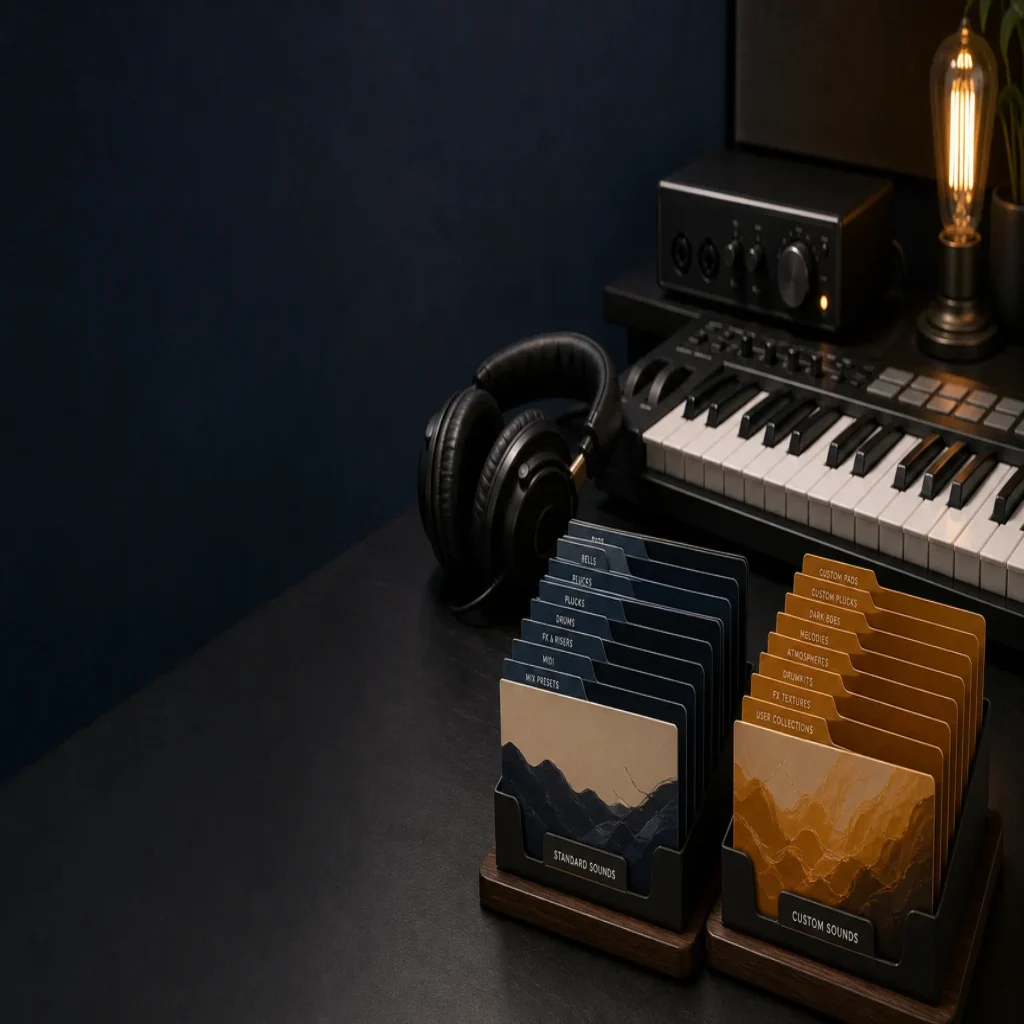
Summary: Custom sound packs are worth more than standard ones only when personalization, exclusivity, and ongoing access solve a real production need. A standard pack is often the better choice for testing a genre, expanding a limited palette, or controlling costs. The right decision depends on usage, genre fit, workflow savings, licensing, and compatibility.
A custom sound pack is not automatically better because it costs more. The premium becomes rational when the sounds match your production identity, reduce preset hunting, and give you content you are unlikely to find in a generic library. For producers working in melodic trap, drill, dark trap, phonk, pluggnb, or related styles, our custom sound pack edition shows what a higher tier can add beyond a standard bank.
In practice, producers judge pack value through several connected factors: time saved, sound quality, genre fit, usability in a real DAW, and the number of sounds that survive a full session. A practical producer value guide makes the same distinction between useful production tools and libraries that create digital clutter.
What does a custom pack actually add?
The meaningful difference is not the word “custom” on the product page. It is the extent to which the pack reflects your needs rather than serving a broad audience.
A standard pack is usually designed around a defined genre or instrument. It may include presets for Serum, Vital, Omnisphere, Kontakt, or a dedicated VST, along with drums, MIDI, loops, and effects. You choose from a prepared palette and adapt it to your own workflow. That structure keeps the price lower and makes the product easier to distribute to many producers.
A custom pack can go further in four ways:
- Custom sound design built around a preferred mood, drum character, melodic style, or reference direction.
- Content exclusivity, meaning material created for a limited buyer group or for one producer’s identity.
- Workflow alignment, such as naming, preset organization, MIDI content, and sound categories that match the way you build beats.
- Extended access, which may include future releases, additional kits, or a larger private library.
These additions matter because they can remove decisions from the production process. If you regularly lose time auditioning hundreds of presets before finding one usable bell, pad, 808, or pluck, a focused bank can have practical value even when it contains fewer total files than a large generic collection.
However, customization does not guarantee that every sound will fit your taste. A producer who enjoys building patches from an init preset in Serum or Vital may gain more from a standard sound bank that provides ideas without defining the direction. The premium should therefore pay for a better fit, not simply a larger number of files.
When does the price premium make sense?
The higher price makes sense when you can connect it to a measurable production benefit. A custom pack should help you finish more tracks, develop a recognizable palette, or avoid buying several overlapping libraries.
Our own 2026 product ladder illustrates the difference. Pendora Lite is priced at $29 or €29 and includes 30 hand-picked presets, bonus kits, and a MIDI pack. The full Pendora edition provides 275 or more studio-ready sounds and additional production assets. Pendora Ultimate is listed at $500 or €500 and adds custom content, a custom name on the first preset, all Tiger-Sounds kits, lifetime access to upcoming kits, and more than 5,000 exclusive MIDI melodies.
The custom tier is therefore not just a larger standard pack. It is intended for a small number of producers who value personalization and broader long-term access. A preset pack economics guide makes a useful buyer-side point: the real purchase is often time, not talent. A finished preset can remove a technical task, but it cannot replace arrangement, mixing decisions, or musical judgment.
For a custom pack to justify a large premium, most of the following should be true:
- You already know your preferred genres, tempos, keys, and sonic references.
- You produce frequently enough to use the content over many projects.
- You want sounds that support a recognizable identity rather than broad experimentation.
- You value private or limited content more than a low entry price.
- The license clearly allows your intended commercial use.
- The pack works in your operating system, DAW, and plugin format.
Why do standard packs still win for many producers?
A standard pack is usually the better purchase when your needs are still changing. Beginners and developing beatmakers may not yet know whether they prefer dark trap, boom bap, phonk, pluggnb, or a more melodic R&B direction. Paying for exclusive content before identifying that direction can create expensive unused material.
Standard packs also work well when you want variety. A prepared library can introduce new drum textures, chord movements, orchestral layers, bells, plucks, risers, and 808 patterns without requiring a custom brief. It can support beatmaking in FL Studio, Ableton Live, Logic Pro, Cubase, Pro Tools, or Reason, provided the product supports the relevant VST3 or AU format.
Our lite versus full sound banks comparison reflects this staged approach. A smaller entry edition lets a producer test the sound and workflow before moving to a broader package. That is often more responsible than buying a high-priced custom library based only on a short demo.
Standard packs are especially sensible when:
- You are still learning how to edit envelopes, filters, macros, and effects in Serum, Vital, or another synthesizer.
- You need a broad starting palette for several genres.
- Your budget is limited or your release schedule is irregular.
- You enjoy transforming presets with your own processing.
- You want to compare a producer’s sound before commissioning or buying more content.
There is also a practical issue of attention. A large or customized library can still overwhelm you if its folders are poorly organized. A smaller standard pack with clear categories may produce results faster than a premium collection that requires extensive browsing.
Can you measure the return before buying?
You can estimate the return by tracking usage rather than counting files. The headline number of presets, loops, or MIDI patterns is only a starting point. The more useful question is how many sounds you can imagine using in your next three or five sessions.
Listen to the demonstrations in context, then audition the dry or minimally processed sounds when possible. A polished demo can make almost any preset appear more useful than it is. Check whether the pack contains sounds that work under a kick and 808, sit inside a dense arrangement, and remain flexible after pitch, envelope, and effects changes.
A simple calculation can clarify the decision:
- Estimate how many finished tracks you will make during the next year.
- Estimate how many sounds from the pack you are likely to use per track.
- Calculate the approximate cost per realistically used sound.
- Estimate the time saved compared with designing or searching for those sounds yourself.
- Check whether the license supports beats, placements, sync work, or other commercial uses you expect.
For example, a $29 standard pack may be worthwhile if it gives you ten reliable presets and several usable MIDI ideas. A $500 custom pack may also be worthwhile if it becomes the core of dozens of tracks, gives you a distinct sound direction, and includes content you would otherwise commission separately. If you only use two sounds from either option, the cheaper pack is still the less expensive mistake.
Our guide on whether a pay-once sound pack is worth the money is relevant here because ownership structure affects the calculation. A one-time purchase can be easier to justify when you expect repeated use, but lifetime access does not create value if the content remains unused.
What should you check before choosing either option?
Before paying, separate objective deliverables from subjective promises. “Unique,” “premium,” and “professional” are not enough on their own. You need to know what is included, how it works in your setup, and whether the license matches your release plans.
First, check the technical requirements. Our products support VST3 on Windows and macOS, and AU on macOS. Stated operating system support is macOS 11 Big Sur or later and Windows 10 or 11, 64-bit only, with native Apple Silicon support. Compatibility should still be checked against the exact DAW and computer you use.
Second, review the content types. Presets offer sound starting points, while MIDI gives you editable musical information. Drumkits provide individual hits and patterns, and mix presets or effects can speed up finishing work. A custom pack is more valuable when its content complements your existing tools instead of duplicating what you already own in Serum, Omnisphere, Kontakt, or your DAW library.
Third, read the license. Royalty-free commercial use can allow beats and tracks to be sold, placed, or licensed, but it does not normally permit redistributing the original presets, samples, or files. Our stated terms include royalty-free commercial use and free lifetime updates, while account sharing and redistribution are excluded.
Fourth, compare price with scope. A recent sample pack checklist highlights the importance of sound quality, organization, format support, licensing, and the balance between quantity and usability. Those criteria are more useful than assuming that a higher price always means better results.
As of September 2026, the full Pendora price is shown as €149 on some pages and $147 on another, while the bundle page displays a stated $499 value before the listed $147 purchase price. Treat that discrepancy as something to confirm at checkout. The broader point remains the same: compare the actual contents and terms of each edition rather than judging solely by the displayed anchor price.
So, are custom sound packs worth more?
Custom sound packs are worth more than standard ones when their personalization, exclusivity, and extended access solve a specific production problem. They are not automatically better for beginners, occasional producers, or anyone still exploring their genre. Start with the smallest pack that lets you judge the sound in a real session, then move toward a custom tier only when you can explain exactly what the added content will change in your beatmaking workflow.
Choose a sound bank that fits your workflow
If your main problem is generic presets, slow browsing, or repeated sounds across trap, drill, phonk, dark trap, boom bap, or pluggnb sessions, a focused sound bank may be a better starting point than an oversized library. The right edition should give you usable material without forcing you to pay for content that does not match your production style.
Our unique custom sound pack is designed for producers who want personalized Pendora content, access to Tiger-Sounds kits, extensive MIDI material, and a one-time ownership model under the stated license terms. Review the included content and compatibility before deciding whether the custom tier fits your sessions.
Frequently Asked Questions
Are custom sound packs always more original?
No. Custom production can create a more personal direction, but originality still depends on how you edit, arrange, layer, and process the sounds. A standard pack can also become distinctive when you transform it carefully.
Is a standard sound pack better for beginners?
Often, yes, because it lets beginners test a genre and learn how presets, MIDI, drums, and effects work without a large commitment. A smaller entry product can also reveal whether the workflow suits the producer before a broader purchase.
What makes a custom sound pack worth its price?
The strongest reasons are repeated use, meaningful personalization, limited or exclusive content, and a clear improvement in workflow. The pack should save enough time or support enough releases to justify the difference from a standard option.
Can I use a paid sound pack in commercial beats?
That depends on the specific license. Our Pendora editions include royalty-free commercial usage under the stated terms, while redistribution and account sharing are excluded, so always review the applicable license before releasing or reselling content.
Is Pendora the same as Cymatics PANDORA?
No. Pendora VST is made by Tiger-Sounds, while Cymatics PANDORA is an unrelated product. Check the developer name, format requirements, and official product documentation before installing or purchasing either plugin.