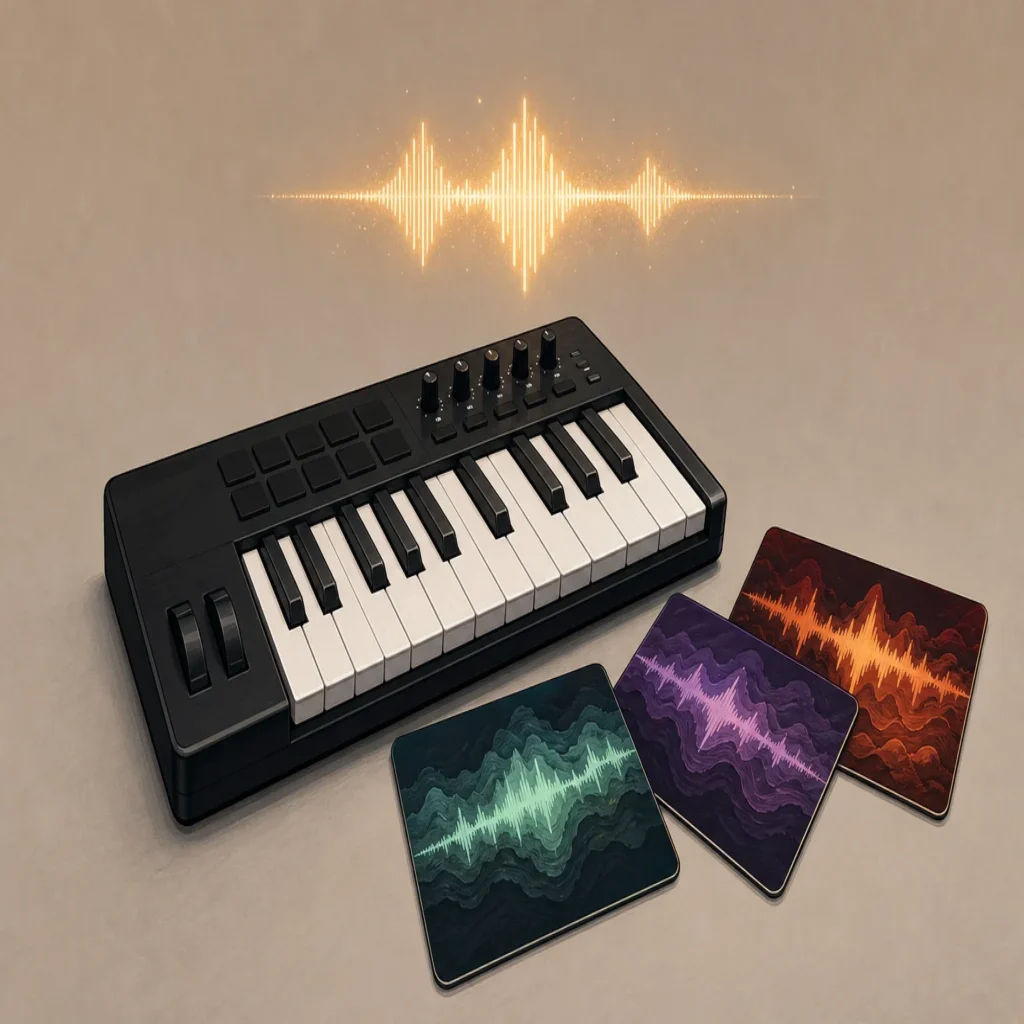
Summary: A boutique sound bank is a deliberately curated collection of playable sounds, often built around a particular genre, workflow, or sound-design approach. For producers, its value depends on useful presets, a clear sonic identity, compatible formats, and licensing that fits the planned release. It is a focused tool, not a guarantee of originality or a replacement for production choices.
A preset can be technically polished and still send a beat in the wrong direction. A boutique sound bank aims to offer a more deliberate starting palette, with sounds chosen for a narrower musical purpose rather than sheer quantity. If you are weighing whether that focus matters, what makes custom sound packs different can help clarify what curation and a defined sound identity might add.
What is a boutique sound bank for producers? It is a sound library or virtual instrument whose selection is intentionally shaped by a specialist creator, often around specific genres, techniques, or production needs. The label itself is not a technical standard, so look beyond the word “boutique” and check what the bank contains, how it works in your DAW, and whether its sounds suit the music you actually make.
What does “boutique” mean in a sound bank?
Imagine opening a preset browser and finding a compact set of sounds that share a recognizable character. That intentional selection is the central idea behind a boutique bank. Rather than competing on the largest possible preset count, it may focus on a particular palette, such as dark melodic tones, expressive keys, or sounds suited to a narrow group of genres.
There is no universal definition or required size. One creator may use “boutique” to describe a small collection made by a specialist sound designer; another may use it for a larger instrument with a distinct genre focus. The label does not, by itself, prove that the sounds are original, hand-crafted, exclusive, or free of licensed material. Those are specific product claims to verify separately.
For a producer, the useful question is whether the selection helps solve a real session problem. A focused bank may reduce browsing when you already know the style you want, but a narrower palette may offer less variety for projects outside that lane. Check the sound demos and the actual contents rather than judging the product by its positioning alone.
How is it different from a broad library or sample pack?
The distinction is easiest to hear in the workflow. A sound bank generally provides presets inside an instrument, so you can play a sound with MIDI, change the notes, and shape the patch using the available controls. A sample pack typically provides audio files such as drum one-shots, loops, vocals, or effects that you arrange and process directly in your project.
These categories can overlap. A sound bank may come with MIDI, drumkits, or audio effects, while a sample pack may include presets for Serum, Vital, Kontakt, or another instrument. For a closer look at the practical difference, see sound banks vs. sample packs. In either case, inspect the included formats instead of relying on the product name.
A broad library can suit producers who move between many styles or want a wide range of sounds to explore. A boutique bank may be more convenient when a defined palette fits the current project. Neither size nor category guarantees that a sound will work in a mix: the notes, arrangement, processing, and context still matter.
When can a focused palette help beatmaking?
When a session feels stuck, the useful next sound is not necessarily the newest or most popular one. It is the sound that gives you a workable direction. A focused bank can help by presenting a smaller group of related starting points, making it easier to audition a pluck, pad, bass, or key sound against the chords and drums you already have.
Genre fit matters here. A bank built around melodic trap, drill, R&B, pluggnb, dark trap, lofi, or phonk may be relevant to those sessions, but the same selection may not serve every style equally. Browse by useful categories, listen to sounds in a full musical context, and check whether they leave room for your own MIDI, automation, and processing.
Music-selection patterns in other creative work can offer context, but they are not a buying guide for instruments. Berklee’s 2026 music and video survey found that 83.7% of surveyed participants had chosen a trending sound before shaping video content around it. That finding concerns video decisions, not sound-bank purchases; it is a reminder that a sound’s popularity does not establish whether it fits your beat.
Which content and workflow details should you inspect?
Start with the playable sounds, then ask whether the included extras support your usual process. Useful checks include the range of presets, the kinds of basses and melodic sounds included, how categories are organized, and whether the bank supplies MIDI, drums, effects, or other production assets. A large count is only meaningful if you can find sounds you will actually use.
We built Pendora as a genre-focused example rather than a definition of the category. Our full edition includes more than 275 presets across more than 30 sound categories, with additional production assets such as expansion packs, drumkits, MIDI, and effects. The selection is aimed at trap, drill, phonk, dark trap, boom bap, pluggnb, and related production styles. We have operated since 2020, and our presets and production assets are described as hand-crafted by our small team. Those details show what our product contains; they do not establish how other boutique banks are made.
Try sounds in a real project before deciding. Load a preset, write a short MIDI phrase, and hear whether it sits with your drums and bass. A sound that impresses in isolation may need substantial processing or may occupy the same frequency range as another part. If you want a wider view of available options, compare the best sound banks for producers using content, genre fit, usability, and licensing rather than preset count alone.
What should you check before buying?
Begin with compatibility. Confirm your operating system, processor architecture, plugin format, and DAW version, then check the product maker’s supported-host information. VST3 support and AU support are not interchangeable: the format needs to match your system and host. For example, Pendora supports VST3 on Windows and macOS, and AU on macOS; its stated system support is macOS 11 Big Sur or later and 64-bit Windows 10 or 11.
Next, review the license for the exact edition you plan to use. “Royalty-free” does not automatically mean you can share, resell, or redistribute the original presets and files. Pendora allows royalty-free commercial use under its product terms, while account sharing and redistribution are excluded. For any bank, make sure the permitted use covers your intended beats, placements, or releases, and keep the original content separate from the finished music you create with it.
Industry-level market reports cannot answer product-specific questions about formats, licenses, or sound quality. NAMM’s 2026 Global Report provides broader music-products market intelligence, but choosing a bank still requires checking its own documentation. Likewise, IFPI reported global recorded music revenues of $31.7 billion in 2025 in its 2026 report, a figure about the recorded music industry, not a measure of sound-bank sales or a guide to plugin licensing. A product’s own terms remain the relevant source for what you may do with its content.
Finally, consider workflow and value over time. Check installation steps, storage requirements, update policy, support, and whether you pay once or on a recurring basis. If you are unsure about the sound or compatibility, a smaller evaluation option can make more sense than committing to a larger collection before testing it in your own sessions.
Choose the bank that fits your sessions
A boutique sound bank for producers is a curated starting palette, often organized around a particular creative direction. Its practical value comes from the relevance of its sounds, the ease of using them in your DAW, and clear licensing, not from the “boutique” label or a high preset count. Audition it in context, check compatibility and terms, and choose the option that helps you make the music you intend to finish.
Try a focused sound bank in your workflow
If your sessions often slow down during preset browsing, a genre-focused instrument can give you a more direct starting point. Pendora is designed for beatmakers working in trap, drill, phonk, dark trap, boom bap, pluggnb, and related styles, with melodic sounds and supporting production assets in one workflow.
Our full edition includes more than 275 presets across 30+ sound categories, alongside kits, MIDI, and effects. Pendora supports VST3 hosts on Windows and macOS, plus AU hosts on macOS; check the stated system requirements and licensing terms against your setup and intended use. Explore the Pendora sound bank to review the available contents and compatibility details before choosing an edition.
Frequently Asked Questions
Is a boutique sound bank a specific plugin format?
No. “Boutique” describes a product’s curated or specialist positioning, not a required format. Check whether the actual instrument supports the plugin format and DAW you use.
Is a boutique sound bank the same as a sample pack?
Not necessarily. A sound bank usually centers on playable presets inside an instrument, while a sample pack often contains audio files such as loops and one-shots, though a product can include both.
Can a focused sound bank help with beatblock?
A smaller, genre-relevant palette may make it easier to find a starting sound when browsing is slowing a session. It cannot supply the musical decisions, arrangement, or processing that make the beat your own.
What should I check before using presets commercially?
Read the license for the exact product and edition, including its rules on commercial releases, sharing, and redistribution. Do not assume that “royalty-free” permits distribution of the original preset files.
What is Pendora, and how does it fit this category?
Pendora is our boutique sound-bank virtual instrument, focused on trap, drill, phonk, dark trap, boom bap, pluggnb, and related styles. Its full edition combines more than 275 presets with additional production assets, so check the product page for current contents and compatibility.