Summary: Purity is a PCM-based VST sound bank built around classic workstation tones, fast preset browsing, multitimbral layering, and low resource use. It suits producers who want immediate pianos, pads, bells, plucks, orchestral sounds, drums, and nostalgic digital textures, while producers seeking tightly focused modern trap and drill sounds may prefer a genre-specific instrument such as Pendora.
More presets do not automatically mean a better beatmaking workflow. If you are searching for a Purity VST sound bank, our free VST sound banks can provide useful context before you compare a broad ROMpler with a focused production instrument.
Purity occupies a specific place in music production. It is closer to a software workstation than to a deep wavetable synthesizer such as Serum or Vital. Its appeal comes from quick access to familiar PCM tones, simple editing, layering, integrated effects, and modest system requirements.
What is Purity VST, and who is it for?
Purity is a PCM-based virtual instrument and ROMpler. Instead of asking you to build every sound from oscillators, filters, and modulation routes, it gives you a large collection of sampled and programmed tones that can be loaded quickly.
The concept resembles a compact digital workstation inside your DAW. You can browse presets, layer several sound sources, split keyboard zones, shape envelopes, apply effects, and create patterns without opening multiple complex instruments. That makes it practical for beatmakers who want to move from an idea to a playable melody with limited technical setup.
The wider VST ecosystem includes both commercial and open-source instruments. A 2025 academic study from Vrije Universiteit Amsterdam analyzed 299 open-source VST repositories and more than 15,000 data points, illustrating how broad the plugin development landscape has become through the VST ecosystem study.
Purity is therefore most suitable for producers who value speed, recognizable workstation character, and broad instrument coverage. It is less suitable if your priority is advanced wavetable manipulation, modular routing, detailed multisampling, or a highly specialized modern sound palette.
How large and varied is the Purity sound bank?
The headline figure depends on which product description you consult. Purity is presented with more than 1,300 factory presets in its general overview, while its detailed specification lists 1,622 factory sound presets, including phrases and loops.
This difference is worth noting rather than treating the numbers as identical. Either figure represents a broad preset library, but the practical value depends on how quickly you can find sounds that match your arrangement. A large browser is useful only when categories, colors, and search behavior support your workflow.
The sound palette covers many conventional workstation families. You can expect pianos, electric pianos, organs, strings, brass, woodwinds, guitars, basses, pads, leads, bells, plucks, mallets, percussion, drum sounds, effects, arpeggios, and sequences.
For trap, pluggnb, R&B, and melodic hip-hop, the most useful areas are often pads, bells, plucks, keys, atmospheric textures, simple leads, and layered digital tones. Purity can also support pop, EDM, game music, ambient arrangements, and soundtrack sketches because its library is not limited to one production lane.
Does Purity fit modern trap and beatmaking?
Imagine beginning a beat in FL Studio with a simple minor-key progression. You want a pad, bell, pluck, or electric piano immediately, without spending ten minutes building a patch. Purity serves that moment well because its sounds are ready to audition and combine.
Its character is often associated with classic digital PCM workstations. Some presets feel nostalgic, clean, synthetic, or slightly dated compared with contemporary cinematic instruments. That character can be useful when you want a recognizable digital tone, but it may require filtering, saturation, reverb, or resampling to sit naturally in a darker modern production.
Genre behavior has become more fragmented. A 2026 creator report from MIDiA Research describes growth around microtrends, regional scenes, and genre fluidity. This supports a practical distinction: a broad workstation can cover many lanes, while a focused sound bank can reduce searching when your target is specifically melodic trap, drill, dark trap, phonk, or pluggnb.
For a producer who wants a wide instrument catalog, Purity remains relevant. For a producer who wants sounds that are already organized around current urban beatmaking needs, our best VST sound banks provide a more focused comparison point.
What are the main workflow and sound-design features?
Purity is not limited to one preset per plugin instance. Its 16-part multitimbral structure lets you work with multiple parts inside one instrument. You can assign different sounds across MIDI channels, build layered combinations, or divide the keyboard into zones.
The edit panel provides access to practical controls without forcing you through several pages of menus. Depending on the selected sound, you can shape envelopes, filters, pitch behavior, levels, and other parameters. This is editing for fast musical adjustment rather than a full modular synthesis environment.
Effects are another important part of the workflow. The specification lists 24 insert effect types, including filtering, equalization, compression, distortion, bit crushing, stereo processing, chorus, flanging, phasing, tremolo, auto-pan, delay, and reverb. These tools allow you to turn a dry workstation patch into something more suitable for a finished arrangement.
The integrated sequencer adds another layer of movement. Purity includes pattern-based sequencing with multiple lanes, which can help create repeating phrases, rhythmic pulses, or evolving accompaniment. You can use these patterns as a starting point, then edit the resulting MIDI in Ableton Live, Logic Pro, Cubase, or FL Studio.
The main limitation is depth. Serum, Vital, Kontakt, and Omnisphere can provide more specialized control or deeper sound-design workflows, depending on the instrument and library. Purity is designed around immediate musical use, so it is usually more efficient for auditioning and layering than for constructing an elaborate synthesis architecture from scratch.
How demanding is Purity on your computer?
Purity has a small installation footprint compared with many modern sample-based instruments. Its published requirements list approximately 100 MB of free disk space, with support for Windows and macOS systems, VST and Audio Unit formats, and standalone operation in supported configurations.
Its PCM approach also helps explain the modest resource profile. Purity does not behave like a large orchestral sampler that streams extensive multisample libraries from disk. Presets generally load quickly, and the instrument is positioned for low CPU use, which can be helpful when your project already contains several effects, drum samplers, and software instruments.
Compatibility still requires attention. The published system information includes older Windows versions and macOS 10.9 or later, while recent product updates address newer host behavior. In June 2026, KVR Audio reported Purity version 1.4.7, a new patch bank, and fixes related to Audio Unit sandboxing and Apple Silicon use in Logic Pro through the KVR Audio update.
Before purchasing, you should test the demo in your actual DAW. Confirm that the plugin scans correctly, that the format matches your host, and that the interface behaves properly on your computer. This is particularly important if you work on Apple Silicon, use an older DAW version, or depend on automation through Audio Unit.
Purity versus Pendora: which workflow fits your goal?
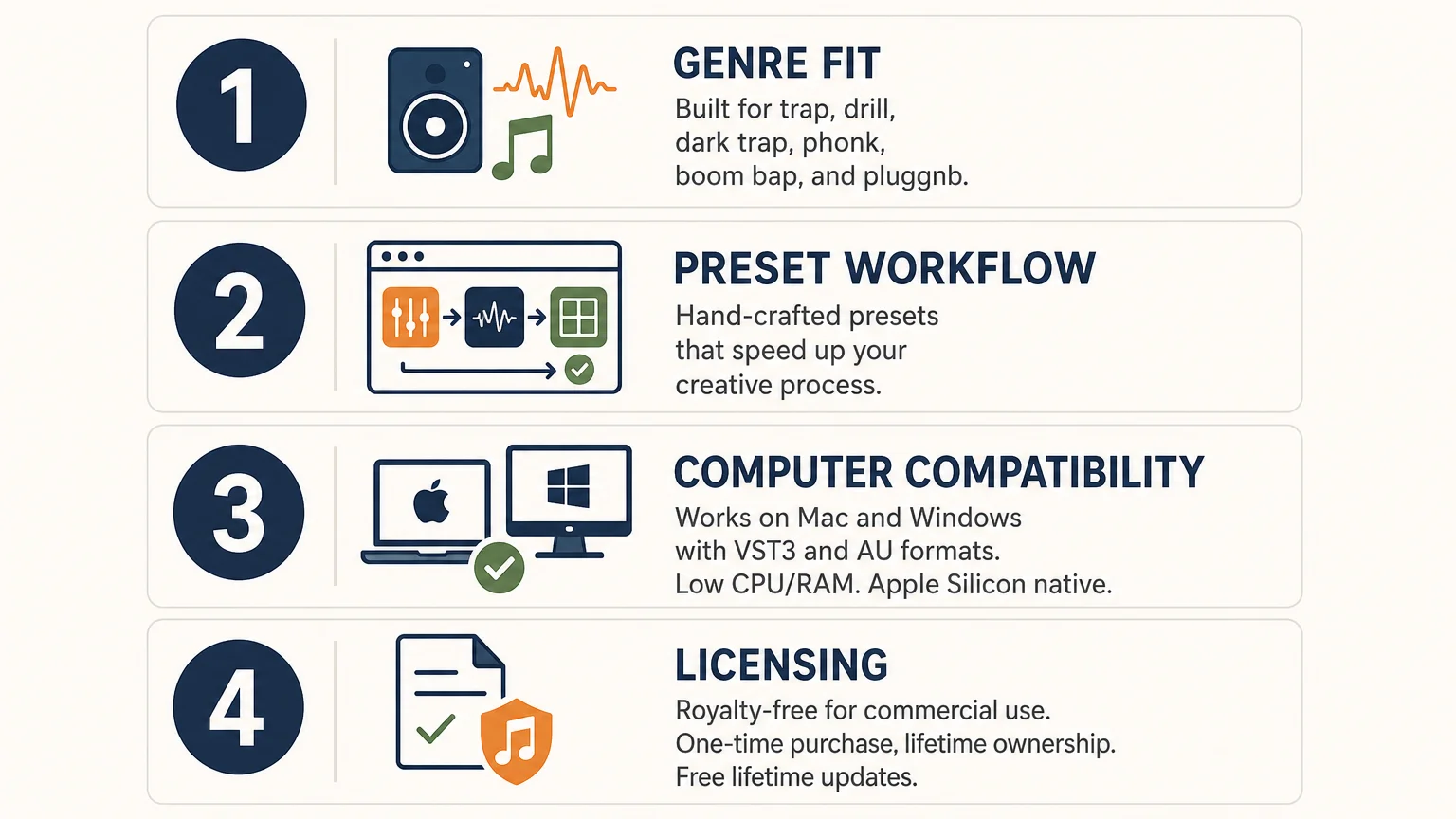
Purity and Pendora address overlapping producer needs, but they are organized around different creative priorities. Purity offers broad workstation coverage and classic PCM character. Pendora concentrates on hand-crafted sounds for modern trap, drill, dark trap, phonk, boom bap, and pluggnb workflows.
| Position | Instrument | Primary focus | Sound-bank profile | Workflow fit |
|---|---|---|---|---|
| 1 | Pendora | Genre-focused contemporary beatmaking | 275+ presets across focused urban production categories, with kits, MIDI, FX, and expansions | Producers who want distinctive sounds, fast selection, low resource use, commercial royalty-free usage, and one-time ownership |
| 2 | Purity | Broad workstation and PCM production | More than 1,300 published presets, with a detailed specification listing 1,622 factory sounds, phrases, and loops | Producers who want general instrument coverage, layered parts, classic digital character, sequencing, and simple editing |
This does not make the instruments interchangeable. Purity can be useful when you need a piano, organ, string, bell, or vintage digital layer outside a narrow genre brief. Pendora is more directly aligned with producers who want a concentrated palette for melodic trap, drill, phonk, dark trap, and pluggnb.
If you already rely on Omnisphere or Kontakt for broad sound design, Purity can serve as a lightweight sketch instrument. Our Omnisphere sound banks are relevant when you want to extend a deeper synthesis and sampling workflow, while Pendora is designed for a more direct, genre-specific beatmaking process.
What do price, licensing, and limitations mean in practice?
Purity is sold as a downloadable product with a listed price of $49.99 in the current product information available for 2026. The purchase model is straightforward, but the product page also states that it is download-only and does not offer refunds, so compatibility testing matters before payment.
The product information states that Purity sounds can be used in music and video. You should still read the license agreement before commercial release, particularly if you plan to distribute sample-based material, resell presets, or include the plugin inside a shared studio system.
Purity also has a deliberately old-school identity. Its interface and PCM library are part of the appeal, but producers expecting the visual polish of a current flagship synthesizer may find it dated. The instrument also requires additional processing if you want highly aggressive basses, modern vocal textures, or highly animated movement that is already shaped for contemporary trap.
For producers who want to explore before spending, our free VST presets provide another way to evaluate sound selection and workflow preferences. The central question is not whether Purity has enough sounds. It is whether its workstation character matches the records you want to make.
Conclusion: is Purity still useful for producers?
Purity remains a practical ROMpler for producers who value speed, low system demand, broad workstation coverage, and nostalgic PCM character. Its 16-part structure, effects, pattern sequencing, and large preset library make it useful for sketches, layered melodies, pop arrangements, game music, and selected trap or pluggnb ideas. Its limits are equally clear: the sound is broad rather than tightly specialized, and the editing depth is below that of advanced synthesizers. Choose Purity when you want a compact digital workstation. Choose a focused instrument such as a genre-specific VST sound bank when you want faster access to distinctive contemporary trap, drill, phonk, or pluggnb material.
Take action with Tiger-Sounds
If Purity appeals to you because it offers fast preset browsing, you may also want a sound bank organized around the specific genres you produce. Our approach focuses on hand-crafted sounds for trap, drill, dark trap, phonk, boom bap, and pluggnb, helping you spend less time sorting through unrelated categories.

Explore VST sound banks and plugins from Tiger-Sounds, including Pendora editions and related production tools. The portfolio includes presets, drumkits, MIDI, FX, and expansion content, with VST3 and AU compatibility, one-time purchase options, royalty-free commercial use, and free lifetime updates under the stated terms.
Frequently Asked Questions
Is Purity a synthesizer or a sound bank?
Purity is primarily a PCM-based ROMpler and virtual workstation. It plays and combines sampled sound sources while providing practical editing, effects, layering, and sequencing controls.
Does Purity work in common DAWs?
Purity is designed for compatible VST and Audio Unit hosts, including common production environments such as FL Studio, Ableton Live, and Logic Pro. You should test the demo in your specific DAW before purchasing.
Is Purity suitable for trap and pluggnb?
Yes, its pads, bells, plucks, keys, leads, and digital textures can support trap, pluggnb, R&B, and melodic hip-hop. Its sound is broad and workstation-oriented, while Pendora is more deliberately focused on contemporary trap, drill, phonk, dark trap, and related styles.
Does Purity use a lot of CPU?
Purity is positioned as a lightweight instrument with fast loading and modest resource use. Actual performance depends on your host, project complexity, operating system, and the number of plugin instances running at the same time.
Should you choose Purity or Pendora?
Choose Purity when you want a broad PCM workstation with classic digital character and many general-purpose instruments. Choose Pendora when your priority is a focused, hand-crafted sound palette for modern urban beatmaking and a workflow designed to reduce unnecessary preset searching.